

People with intellectual and developmental disabilities (IDD) are more likely to die from COVID-19 than those without, according to a study.


The authors of the paper published in the journal Disability and Health Journal believe that the between 2.6 to four million people in the U.S. who have an intellectual or developmental disability, such as cerebral palsy or Down’s syndrome, may be vulnerable because they are more likely to have underlying conditions such as high blood pressure, heart and respiratory diseases, and diabetes.
These conditions are thought to increase the risk of developing complications from COVID-19, the disease that has killed more than 360,437 people in 5.8 million cases since late last year, according to Johns Hopkins University. Over 2.4 million people are known to have recovered.
The researchers looked at information on all COVID-19 patients included in a global electronic medical records database between January 20 and May 14, 2020. The real-time database included information from 42 health care organizations, including hospitals, primary care, and speciality treatment providers.
They categorized the patients by age and whether they lived in or outside the U.S., and compared COVID-19 death rates and underlying medical conditions in those with and without IDD.
The researchers were unable to clearly distinguish between deaths specifically related to COVID-19 from the data, so they counted COVID-19 deaths as those documented up to 30 days after the patient was diagnosed in the hope this would minimize miscounting fatalities related to other causes.


Of the 30,282 patients included in the analysis, 474 had some form of IDD and 29,808 did not. The most common were pervasive and specific developmental disorders, an umbrella term for conditions including autism and Asperger’s. Thirty three percent had an intellectual disability, 18 percent cerebral palsy, 21 percent a chromosomal abnormality, and 5 percent Down’s syndrome.
Across every age group, underlying health conditions were “noticeably higher” in patients with IDD versus those without. The study revealed rates of respiratory diseases were around a fifth higher, and disorders relating to nutrition, the metabolism and the hormone-producing endocrine system were 34 to 41 percent higher. People with IDDs were also more likely to have circulatory problems, reducing with age from 35 percent in 0 to 17-year-olds to 27 percent in those aged 75 and above.
Case fatality rates, or the proportion of people who die in out of the confirmed cases of the disease, were “similar” for those with and without IDD, at 5.1 percent and 5.4 percent. However, when they looked at disparities between age groups, they found people with IDD had a greater risk of death. People with IDD aged between 18 to 74-years-old had a higher case fatality rate than those without, at 4.5 percent and 2.7 percent, respectively.
This pattern was not seen in the over 75s, they note.There may be a number of reasons for this, the authors said, including differences in rates of comorbidities, and the possibility that a disproportionate number of people with IDD die at younger ages than others.
“Based upon the case fatality rates we report among those ages 18 to 74, if 100,000 individuals with IDD contract COVID-19—which is entirely possible in light of the estimates of the size of this population and the cumulative incidence rates we are seeing in our research—we would expect 4,500 to die,” study co-author Scott Landes, associate professor of sociology at Syracuse University’s Maxwell School of Citizenship and Public Affairs, said in a statement.
“Comparatively, among 100,000 individuals without IDD, we would expect 2,700 to die. That would be an excess of 1,800 IDD deaths and in my mind that is unacceptable.”
The authors acknowledged their study was limited as the database had a small number of IDD cases, which made it hard for them to split the patients into smaller age groups.
Also, the findings may not relate to a wider population, as the figures came from the 42 health care organizations. Their approach to counting COVID-19 deaths may have also missed deaths linked to COVID-19 outside their 30 day time frame, they said.
“More attention is needed to this vulnerable health population in order to ensure their safety and well-being during this pandemic, including careful attention to the impact of public policies such as PPE [personal protective equipment] prioritization and funding streams on the ability of residential service providers to guarantee quality care during this time,” Landes said.
As the graph by Statista below shows, the U.S. is the country with the most known COVID-19 cases. This week, the death toll in that country passed 100,000.
1 of 3
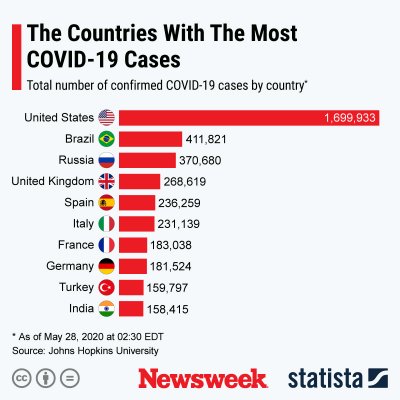 Countries with the most COVID-19 cases. STATISTA
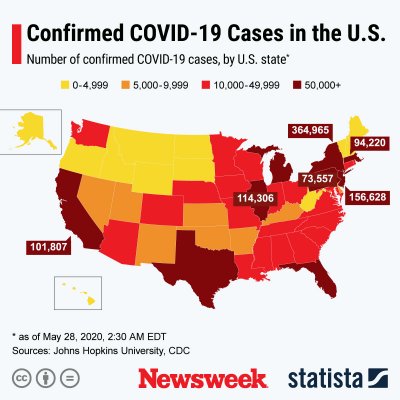 The spread of the COVID-19 outbreak across the U.S. Statista
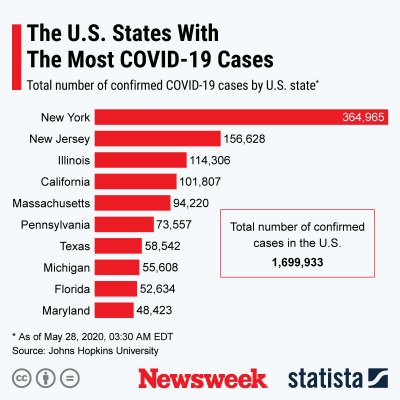 U.S. states with the highest number of confirmed COVID-19 cases. STATISTA


