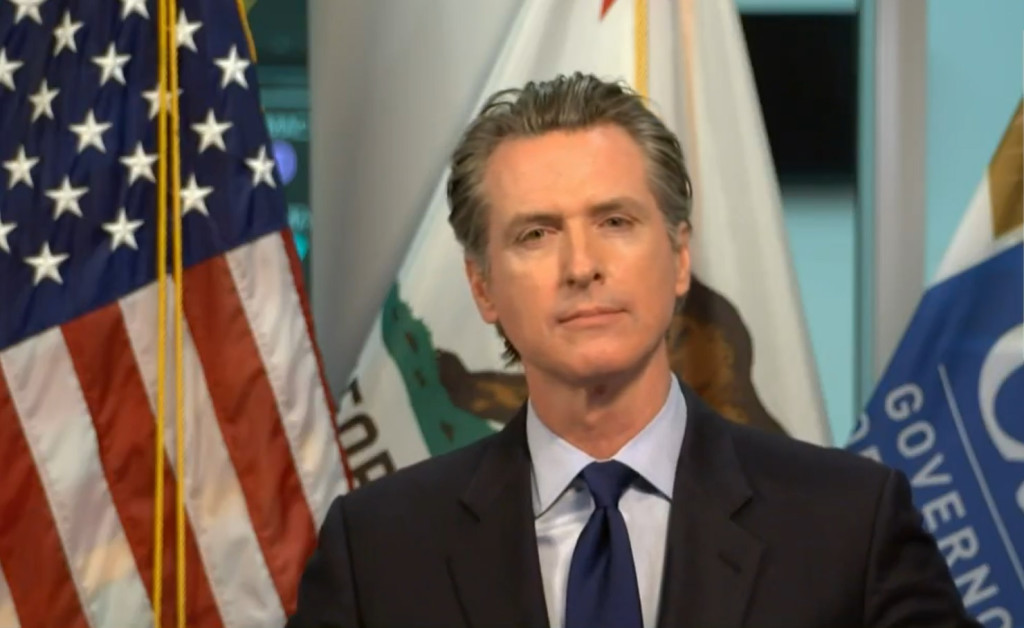
California will draw down reserves, cancel planned program expansions and extra payments to shore up its underfunded pensions and demand even more federal aid to close a $54.3 billion budget chasm caused by the coronavirus pandemic, Gov. Gavin Newsom said Thursday.


“This state was in a strong fiscal condition, strong fiscal health, and we were poised to make historic investments,” Newsom said. “Just like that — almost a blink of an eye — we’re in a completely different position, not just in the state of California, but the entire nation.”
The single biggest proposal toward closing that $54.3 billion gap — $14 billion worth — would come from cuts to programs including state colleges and to state employee compensation that would be “triggered” if the federal government doesn’t provide additional aid beyond the $2 trillion stimulus in March. Newsom specifically referenced a $3 trillion proposal this week from fellow Democrats in Congress.
“The federal government has a moral and ethical and economic obligation to help the states,” Newsom said.
Newsom’s proposal to close the gap also includes:
- $10.4 billion budget maneuvering, including borrowing and transferring from special funds earmarked for specific programs.
- $8.8 billion from reserves, including the state’s $16 billion Rainy Day Fund, only half of which can be spent in one budget year, and $450 million from a Safety Net Reserve.
- $8.4 billion from canceling new spending that Newsom proposed in January, such as expanding health care eligibility and extra payments to shore up the state’s employee pension plans.
- $8.3 billion in federal CARES Act funds from the March stimulus bill, including $4.4 billion for schools to run summer school and other programs to cover learning lost from statewide school closures. The rest includes $3.8 billion for public health and public safety, $1.3 billion to support county public health programs and $450 million for city public safety and homelessness programs.
- $4.4 billion from new revenues from suspending net operating losses and temporarily capping the amount of credits a taxpayer can use in any given tax year.
Overall, Newsom on Thursday shrank his proposed January budget by $19 billion in a revision that accounts for plummeting revenues and soaring costs from the statewide lockdown to slow the coronavirus pandemic.


The revision brings his proposed $222.2 billion overall January budget down to $203.3 billion. The cuts mainly come from the state’s general fund, which pays for schools and universities, health and human services, prisons, transportation and other basic programs. The general fund revision reduces the $153 billion January proposal almost 13% to $133.9 billion.
Newsom last week said California and other states will need a federal bailout to cover their unexpected coronavirus costs, and on Monday joined officials in Oregon, Nevada, Washington and Colorado seeking a combined $1 trillion in aid.
House Democrats proposed a $3 trillion package Tuesday that includes $500 billion in state aid. The Sacramento Bee reported Thursday that California could see $51 billion of that.
But approval is uncertain. Senate Republicans have questioned some of the spending, which comes just two months after the $2 trillion federal stimulus bill.
The “May revise” of California’s budget is typically a modest tweaking of the January spending plan, with adjustments reflecting the actual tax receipts due in April. The Legislature must approve the spending plan next month for the fiscal year that starts in July.
Last year’s revised total budget grew from $209 billion in January to $213.5 billion in May, and $144 billion to $147 billion in the general fund that covers most public services.
Newsom in January proposed a $222.2 billion total budget with $153 billion in general fund spending, looking to spend a $5.6 billion surplus from a surging economy on tackling vexing social problems like homelessness and housing affordability, while also paying down debts and bolstering reserves for a possible downturn.
But last week, Newsom’s finance department said plunging revenues and soaring costs from the COVID-19 pandemic and his March 19 stay-home order aimed at slowing its spread will cost a total of $54.3 billion, nearly three and a half times the state’s Rainy Day reserve fund.
Revenues have fallen by $41.2 billion from businesses being unable to operate and soaring unemployment, while costs have soared $13.1 billion, including $7.1 billion in caseload increases supporting health and human services programs.
The revised budget reduces special fund spending from $63.8 billion to $63.4 billion — special funds are programs such as for vehicle licensing that are paid for out of car taxes and fees. It also raises spending from bond funds for infrastructure from $5.4 billion to $6 billion.
Service Employees International Union Local 1000, the state’s largest employee union, said it was told to expect 10-percent cuts. Newsom said he and his staff would not be spared from the cuts either.
Union President Yvonne Walker said in a video message to members that would amount to two furlough days for the union representing 96,000 state clerical staff, information technology workers, printers, custodians, auditors, nurses and other health care professionals, but that SEIU would push for alternatives.
“We’re going to be looking to you for ideas for cost savings that we can then put forward and try to whittle this down,” Walker said in a video message to members.
But Reform California Chairman Carl DeMaio, a former San Diego city councilman, said Thursday that state workers “will still receive compensation packages far in excess of what is justified in the local labor market” and urged Newsom to cut spending on pension spiking, High Speed Rail and benefits for illegal immigrants.
Check back for more on this breaking story.