
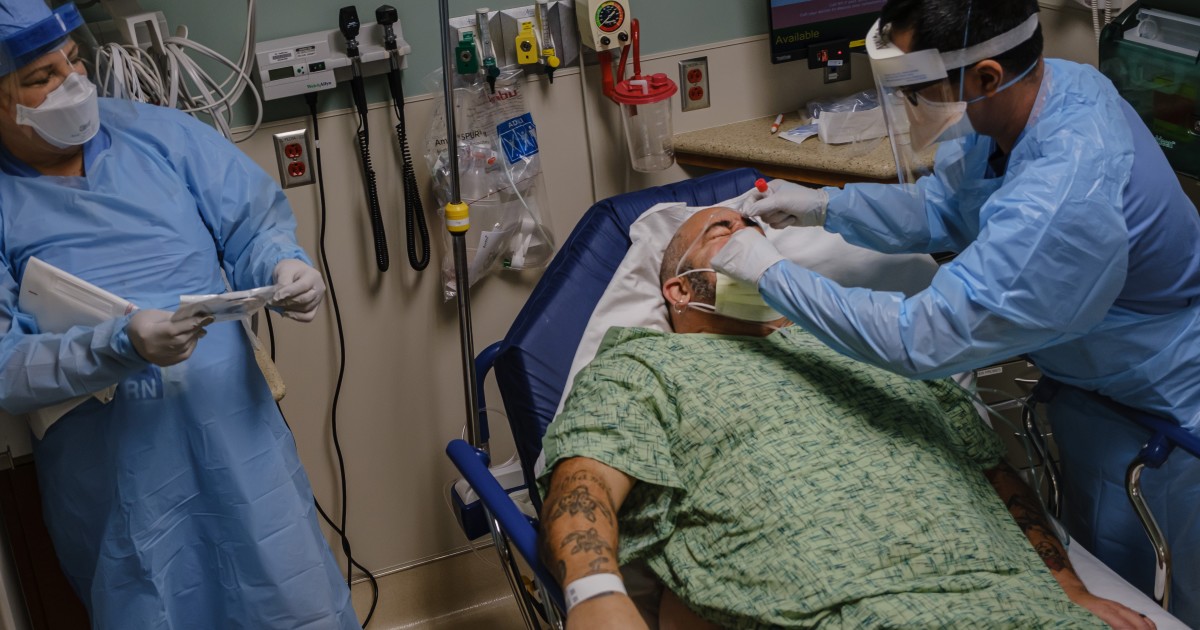
Even as California continues to bend the coronavirus curve, a rise in the number of COVID-19 cases and deaths as well as concerns about a “second wave” of the outbreak are reasons to stay vigilant, officials say.


California has recorded almost 36,000 cases, adding nearly 2,000 on Tuesday alone. Part of the uptick in new cases this week is the result of a lag in labs reporting test results and releasing bulk numbers. More than 1,300 people have died across the state.
Gov. Gavin Newsom and others have said that California and the nation have not necessarily seen the worst of coronavirus and that lifting stay-at-home rules could be disastrous.
“If we all pull back, we could see a second wave that makes this pale in comparison,” Newsom told CBS News. “I don’t anticipate that normalcy that many of us wish for happening anytime soon.”
Advertisement
Concerns about a second wave of coronavirus infections have been echoed by others.
“There’s a possibility that the assault of the virus on our nation next winter will actually be even more difficult than the one we just went through,” Centers for Disease Control and Prevention Director Robert Redfield told the Washington Post. “And when I’ve said this to others, they kind of put their head back. They don’t understand what I mean.”


Redfield said a second wave could be more devastating to the healthcare system if it comes at the same time hospitals were dealing with flu cases.
Advertisement
Some California officials have pointed to the 1918 influenza pandemic, in which the second wave of illness was worse in some cities than the first.
“The really important lesson of 1918 is to keep interventions in place as long as possible,” Alex Navarro, assistant director of the Center for the History of Medicine at the University of Michigan, told The Times last week. “Because once the controls are removed, it’s very difficult to reinstate them.”
Both Los Angeles Mayor Eric Garcetti and San Francisco Mayor London Breed have cited that history in calling for caution.
Last week, Breed said she was well aware of the premature celebrations before the end of the 1918 contagion. She described how the illness “came back with a vengeance.”
Advertisement
With her eye on the present day, she added: “The fact is, it’s not over.… We will get through this. But it is going to require time, and it’s going to require patience, like never before.”
During a news conference Tuesday, Newsom called on Californians to remain cautious in order to protect one another as the number of deaths and hospitalizations continue to rise.
“We’re making progress in the state, but there was a spirit that defined that progress, and that was community,” he said. “If we pull back too quickly, those numbers will go through the roof.”
Advertisement
The governor told residents of communities that have been less affected by the virus to “disabuse” themselves of the idea that they are in the clear. He also said that several counties have reached out to ask about stay-at-home modifications, all with different proposed timelines, which he said he would be addressed Wednesday in the state’s update on its road map to reopening.
“This virus knows no jurisdiction,” the governor said Monday. “Different parts of this state [have been] impacted differently, but … the collective responsibility we have to one another, neighboring counties, neighboring cities, also must be considered.”
Los Angeles County officials on Tuesday confirmed 1,400 more coronavirus cases, 880 of which were part of the backlog from laboratories that had not previously reported results through the county’s electronic system. A similar number had been reported the day before.
Advertisement
L.A. County officials continue to emphasize the need for residents to maintain social distancing practices after a study suggested that tens of thousands of county residents may have been infected with the virus. Without such efforts, that number would be far higher than the more than 15,000 cases that have been confirmed in the county of roughly 10 million people, officials say. More than 89,000 county residents have been tested for COVID-19, Public Health Department Director Barbara Ferrer said.
Los Angeles County’s stay-at-home order was previously extended to May 15, but Ferrer said that date is not a “magic number.” She noted that officials are relying on data and science and working with local hospitals to determine when to lift restrictions, and she asked residents to continue adhering to such directives until told otherwise.
“We have to take responsibly for 10 million people who live in L.A. County,” she said.
Advertisement
Meanwhile, there is new evidence that the virus claimed its first California victims earlier than thought.
Two COVID-19 patients died in Santa Clara County on Feb. 6 and Feb. 17, the county medical examiner revealed Tuesday, making them first documented coronavirus fatalities in the United States.
Until now, the first U.S. fatality was believed to have occurred in Kirkland, Wash., on Feb. 29.
Officials previously had said the first Silicon Valley death was March 9. But that was preceded by the two February deaths, and another person who died of COVID-19 on March 6, the Santa Clara County medical examiner said Tuesday.
Advertisement
Silicon Valley was an early center of the coronavirus outbreak. So far, it has reported nearly 2,000 cases and eight deaths.
There have been growing suspicions that the new coronavirus has been in California longer than experts first believed.
Dr. Jeff Smith, the chief executive of Santa Clara County who is also a physician, said earlier this month that data collected by the CDC, local health departments and others suggest the virus has been in California “a lot longer than we first believed” — most likely since “back in December.”


