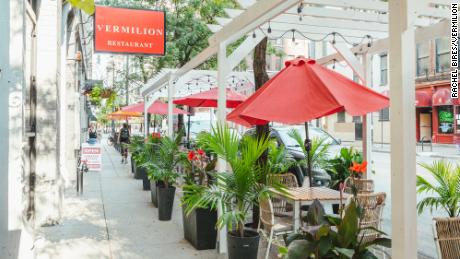
We opened up with outdoor dining last summer and restricted indoor dining, put up plexiglass dividers, implemented weekly testing for our team and enforced mask wearing, temperature logs and distancing. We also used air purification and sanitation, took every precaution we could think of and applied for every conceivable grant. We have feigned normalcy and pivoted every way we could with delivery, takeout, kits, products, experiences and collaborations. All of this was to resume merely 30% of our earlier volume. Since then, a second closure followed from November to January. Now, despite restaurants being allowed to open at restricted capacity in Chicago, we are wrung out and anxious.
This is how it is across the United States. Restaurants have been decimated by the shutdowns caused by the pandemic. After 11 months of being shuttered and restricted, the number of job losses and closures in the restaurant sector is frightening. Even more terrifying is that, according to a Compass Lexecon economic study, 85% of independent restaurants could close for good by the time this crisis ends.

In its last Covid relief package, Congress included a new round of Paycheck Protection Program (PPP) funding for small businesses. The PPP offers restaurants a loan equal to the cost of three and a half months of payroll. It also provides a “second draw” for small businesses that took out a PPP loan in the program’s first round last year and clarifies explicitly that forgiven PPP loans will not be subject to taxes. In addition, the Biden administration recently announced that beginning Wednesday, there will be a two-week window during which only small businesses with fewer than 20 employees can apply for funding.
These changes are helpful, but let me emphasize: The new PPP program alone will not save restaurants. Only targeted grants that do not put small business owners at risk of taking on further debt will give independent restaurants and bars a real chance at surviving.
The first round of PPP loans failed us on many fronts. First, even though the food and accommodation sector contributed nearly a quarter of all jobs lost since the beginning of the pandemic, just $42 billion — a paltry 8.1% — in the first round of PPP aid made it to the entire sector.
To make matters worse, many who received PPP loans either rushed to use them because of the eight-week initial stipulation or could not always use them because demand did not justify the risk of further debt. With unpredictable closures, Covid-19 outbreaks and constantly shifting business models, many of us sat on unused loans.
PPP is anchored on covering a fraction of our payroll — which is a mere 30% of our expenses on average. While the new round of the program allows for slightly more flexibility in spending and covers additional expenses, it is still simply not enough to save independent restaurants and bars from a year’s worth of accumulating bills, rent payments and supplier costs.
With all signs showing that vaccination implementation will take through this summer, even another 16 weeks of PPP leaves us to shoulder all of our other costs while operating under heavy restrictions.
The best program to prevent more restaurants from closing would be a grant program — like that proposed by Sen. Roger Wicker, Sen. Kyrsten Sinema, Rep. Earl Blumenauer and Rep. Brian Fitzpatrick in the bipartisan RESTAURANTS Act. This $120 billion grant program would be much more effective in allowing the independent restaurant community to stay afloat and continue to keep our employees on payroll. Grant amounts would be determined based on a business’ annual revenue losses from 2019 to 2020, with any funds spent from the PPP and Economic Injury Disaster Loan (EIDL) subtracted. This approach would be more effective in allowing restaurants to patch revenue holes and debts and stave off permanent closure and further layoffs. Grants would also be distributed directly from the federal government, bypassing banks to ensure resources are distributed equitably.


A bipartisan coalition in the last Congress signed on to the RESTAURANTS Act. Not only did the House pass this bill in October, but incoming Senate Majority Leader Chuck Schumer of New York has fiercely advocated for it. President Biden has also called for direct relief to independent restaurants.
On February 4th, the RESTAURANTS Act was reintroduced to the new Congress. It already has a groundswell of renewed support, with over 110 House members signing on in the first week. The House will likely vote on a relief package this week, which will reportedly contain $25 billion in grant funds for restaurants, bars and others. It is vital that Congress takes this first step in saving our small businesses and protecting our workers’ livelihoods.
The RESTAURANTS Act is the one shot at redressing a year of neglect and harm inflicted on us and our workers by this pandemic. President Biden, Members of Congress: We are looking to you to keep our industry alive. You have been elected by us. You have been waited on by us. Now, we need you to serve us.