
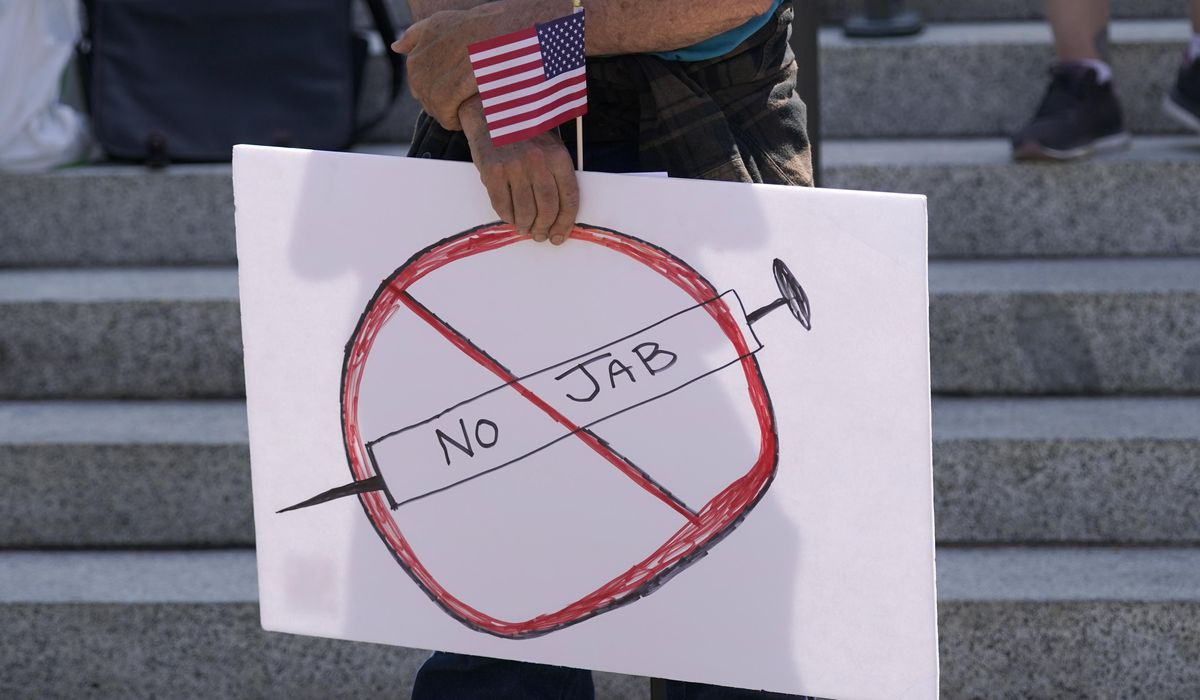
House Republicans told Labor Secretary Marty Walsh on Wednesday to stop work on a regulation that would require COVID-19 vaccination or testing at large private companies, accusing President Biden of weaponizing the federal bureaucracy.


The administration’s mandate, lawmakers say, has the potential to “crush” American businesses that are seeking clarity on hotly debated rules that were outlined weeks ago but haven’t been issued.
Every GOP member of the Education and Labor Committee said the emergency temporary standard being drafted by the Occupational Safety and Health Administration goes beyond the authority Congress granted the agency, bypasses public input and will cause havoc in workplaces.
“This scheme not only passes the buck to workers and job creators, but it also creates massive uncertainty, costs, and liabilities for many employers. As job creators are facing an anemic economic recovery and struggling to find workers, it is unconscionable for the Biden administration to impose such a harmful mandate,” Rep. Virginia Foxx of North Carolina, the ranking member, wrote with fellow Republicans in a letter to Mr. Walsh.
Their call to stop the mandate comes as business groups post laundry lists of questions they have about the regulation, which will apply to roughly 80 million workers.
Mr. Biden announced the plan on Sept. 9 to require businesses with 100 or more workers to mandate the vaccine or weekly testing of those who refuse, though it might be several more weeks before the regulation is released.


The president planned to highlight employer mandates in Chicago on Wednesday but postponed the trip to focus on legislative negotiations in Washington, nudging the issue to the back burner as businesses seek clarity.
“We don’t even know if there is going to be enough tests,” said Ed Egee, vice president of government relations and workforce development at National Retail Federation, whose members include Walmart, Target and Amazon.
The U.S. Chamber of Commerce wants to know what kind of coronavirus tests employers are supposed to use, who will pay for testing and what should happen if an employee refuses vaccination or testing. It also asked for a grace period to let companies get their programs up and running.
The Consumer Brands Association, a trade group representing 2.1 million workers, has similar questions and wants to know how the rules should be applied to workers who recovered from the virus and claim “natural immunity.”
And the National Federation of Independent Business, which famously contested Obamacare, said it objects to the federal government “commandeering of America’s small and independent businesses to serve as the government’s instruments of coercion against their own employees.”
Mr. Biden this month told Republicans and other critics of his plan to “have at it” if they plan to challenge him in court, as he pivots from cheering vaccine mandates at places like United Airlines and leading universities to flexing government power to enact new rules.
“We knew it would take a little bit of time [to issue the rules], given there are some very understandable and good questions by the business community,” White House Press Secretary Jen Psaki said earlier this week.
She said the administration wants to “ensure there’s clarity when they put out the rules” but noted businesses can deploy mandates now, pointing to companies that lifted uptake after imposing a requirement.
“It’s become more popular. It’s been very successful in the vast, vast majority of businesses that have implemented mandates,” she said.
The Democratic National Committee pointed Wednesday to a 99%-plus vaccination rate at United Airlines and the rush of health workers who got vaccinated before a Tuesday deadline in New York State, hoping to build popular support for rules that have been debated at length but remain a work in progress.
Arthur Caplan, director of the division of medical ethics at the New York University Grossman School of Medicine, said no one should be surprised that the OSHA rules aren’t out yet.
“They will be subjected to heated legal challenges so they need to be very carefully crafted. I know some industries are hoping for guidance on mandates — but this not only will go slowly but will immediately be tied up in court,” said Mr. Caplan, who supports mandates. “I doubt we will see enforced federal OSHA mandates ‘til next year. This is hugely sad given the dangerous rise in COVID as we let our guard down in the U.S.A. in our eagerness to go back to normal.”
House Republicans said if anything, the rule is being rushed. They predicted courts will look unfavorably on the regulation because it avoids public comment, and questioned the use of an emergency temporary standard, saying it stretches the authority granted to OSHA by Congress Occupational Safety and Health Act (OSH Act).
“If President Biden or the department seeks to regulate America’s workplaces, such an extreme, intrusive, disruptive, and likely unlawful mandate should either be proposed through formal notice-and-comment rulemaking to allow for review and scrutiny or be initiated through direct congressional authorization,” they told Mr. Walsh.
The NFIB issued a similar demand, effectively daring the administration to go through Congress and face political rewards or consequences.
“If the administration wants to command 80 million Americans, who do not wish to get vaccinated, to get vaccinated or tested weekly, the president should ask Congress to enact legislation issuing that command,” David S. Addington, executive vice president and general counsel at NFIB, told Mr. Walsh in a recent letter. “Then the American people could hold the president, senators, and representatives accountable at the ballot box for how they voted on such legislation. That is the democratic way.”
Mr. Egee said the retail foundation told OSHA it would like to see a 90-day window for companies to comply with the new standard once OSHA puts it forward. He said the NRF doesn’t have a stance on employer vaccine mandates generally — some members were heading in that direction — but they need to know the rule is something feasible, especially as it is pushed under a speedy timeline.
“Usually these things take years and now they’re going to try to do it in weeks,” he told The Washington Times. “I think their approach is totally inconsistent with good government.”
Mr. Egee pointed to Goldman Sachs analysis that found roughly 70% of impacted workers are likely vaccinated already, and about 15% of the unvaccinated will get the shots while the other half of holdouts will be split, with about 9% leaving their jobs and 6% getting tested. He said that still translates to millions of people needing testing supplies, even as parts of the public sector also mandate testing on their workers, while any loss of workers would exacerbate well-documented labor shortages that already exist.
The Washington Times has requested comments from OSHA on how it plans to receive input from businesses and its timeline for completing its work.
In a wrinkle on Capitol Hill, the House Democrats’ massive social-welfare bill includes a tenfold increase in fines for companies that “willfully” or “repeatedly” violate sections of labor law dealing with hazards or serious physical harm to employees, a push that could set the table for hefty enforcement of COVID-19 vaccine rules.
Fines outlined in the 2,465-page bill will reach as high as $70,000 for serious infractions and $700,000 for willful or repeated violations. Previously, the White House said fines would amount to $13,600 per violation of the forthcoming rule.
Sen. Mike Lee, Utah Republican, says the vaccine is safe and effective at preventing severe disease but he plans to decry the mandate from the Senate floor on a regular basis.
“President Biden now wants to force employers to act as a sort of medical police force,” he said Tuesday. “They must impose a vaccine mandate on their workforce or be forced to pay a heavy fine. This mandate is constitutionally dubious, and that’s putting it mildly, and it’s not reasonable and it neglects the interests of business owners, families and individuals alike.”
“A business would risk going under if even a small percentage of its workforce were unvaccinated at the time enforcement begin,” he said. “This is a scare tactic, a scare tactic of the absolute worst sort. And it’s working, people are scared.”


