

Americans have been turning to social media for tutorial videos on how to make homemade face masks from cloth and fabric, both for their own use and for hospitals that are experiencing shortages.


According to the San Francisco Division of Public Health, face masks are one of the tools used to prevent the spread of disease—some people might refer to them as dental, isolation, laser, medical, procedure or surgical masks. The masks are loose-fitting and cover the nose and mouth, which limits the release of tiny droplets from coughs or sneezes into the air, and need to be approved by the U.S. Food and Drug Administration (FDA) for use in a professional and medical setting.
However, these masks are reported to be in short supply in hospitals across the U.S. According to the FDA website, the supply chain for personal protective equipment (PPE) will experience stress during times when demand exceeds supplies and has confirmed that it has been contacted by health care organizations regarding shortages.
“The FDA recommends conservation strategies for use by healthcare organizations and personnel—categorized for a range of clinical needs and supply levels—intended to assist healthcare organizations in determining conservation procedures during this time period,” the FDA website says. “To identify FDA-cleared products, search the 510(k) Premarket Notification database using the product codes for gowns and surgical masks.”
To help hospitals in their communities who are suffering shortages, people are turning their hands to crafts and creativity and are making face masks from cloth and fabric. According to one tutorial on YouTube, all that is needed to make one mask is two pieces of cotton fabric (6 x 9 inches), one piece of cotton flannel or interfacing (6 x 9 inches) and two elastic strips.
But are these face masks safe for hospital staff to use and are they effective against the coronavirus (COVID-19)?


According to the Centers for Disease Control and Prevention (CDC), homemade masks are not considered PPE as their “capability to protect healthcare practitioners is unknown.” The organization cautions people against using them instead of FDA approved masks. This being said, CDC does say that in settings where face masks are not available healthcare professionals could use homemade masks—such as a bandana or a scarf—for the care of patients with COVID-19 as a last resort. It also says that homemade masks should ideally be used in combination with a face shield that covers the entire front (that extends to the chin or below) and sides of the face.
As of 3:01 p.m. EDT, March 24, 2020, 46,548 cases of COVID-19 have been confirmed, according to Johns Hopkins University. Of these cases, 591 have resulted in death, with New York having the highest number of confirmed cases, as the graphic provided by Statista shows below.
The U.S. has the third highest number of confirmed COVID-19 cases globally behind China and Italy respectively.
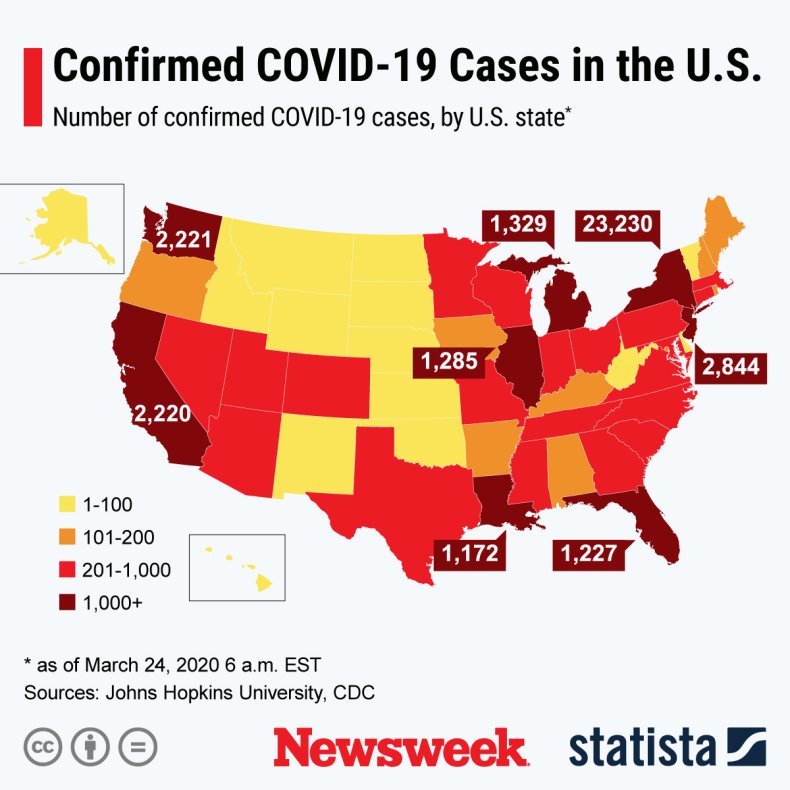 This infographic shows the number of confirmed COVID-19 cases by state.


