


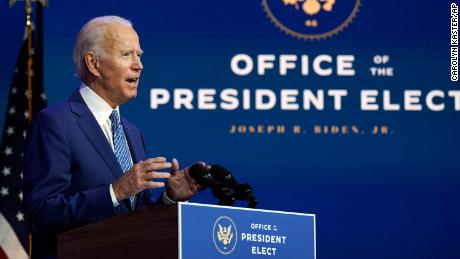
With new cases now topping 160,000 a day in the US, President-elect Joe Biden has already indicated he will be taking swift action to confront the pandemic by appointing doctors and health experts to a coronavirus advisory board. But he won’t be able to implement any plans until he is inaugurated, and the US is in dire straits.
In the midst of a worldwide pandemic, we should all get behind an evidence-based set of scientific standards and practices around the globe, not walk away from them. That’s why it’s important for Biden to reverse President Donald Trump’s pledge to withdraw from the World Health Organization (WHO), and reaffirm the US’ commitment to fund the agency.
Regardless of your views of the WHO and President Trump’s response to the Covid-19 pandemic, there are some important historical lessons to take away from the organization’s origins. Following the end of World War II, a new era of international cooperation took hold with the founding of the United Nations in 1945. There was a sense of urgency in creating the first international health agency following the war’s end, and the WHO was founded three years later to coordinate international responses to public health issues and provide member nations with evidence-based guidelines to classify and eradicate diseases. At the time, public health officials were concerned that the world was ill-prepared for a global pandemic, especially since the 1918 H1NI influenza A virus that killed an estimated 50 million people around the globe broke out around the end of World War I.

Among its many achievements, the WHO initiated a global vaccination campaign in 1959 to rid the world of smallpox, which killed an estimated 300 million people in the 20th century alone. While the disease remained widespread in the mid-1960s in South America, Africa and Asia, the WHO’s efforts succeeded in eradicating the disease on all three continents over the next decade.
A half century later, we are at a crossroads in the global fight against another invisible enemy. The US has failed to lead at home or abroad when it comes to our Covid-19 response efforts, which have been fragmented, chaotic and inconsistent. Meanwhile, our leading public health experts, who have tried to guide us through this crisis, have been shunned, threatened and belittled.
The work of Biden’s new advisory board should prioritize the creation of a pandemic response infrastructure that deploys personnel and resources within our own borders whenever there is an infectious disease outbreak, with priority given to increased lab-testing capabilities, contact tracing, the procurement of personal protective equipment, and the development of early warning and pandemic surveillance systems.
It is also equally important, considering the speed with which infectious diseases spread around the world, to engage more closely with the international community. The US government should take the lead by joining with other world leaders to empanel an international council that would coordinate the standardization and distribution of diagnostic tests, which is especially important in underdeveloped countries where access is limited. The same panel could also serve as a clearing house for prioritizing clinical trials and results for vaccines and therapies, providing objective insight in evaluating the effectiveness and safety of drugs being researched in the US, Russia, China and elsewhere around the globe. International collaboration is also needed for manufacturing and stockpiling ventilators, personal protective equipment, drugs and other essential supplies.


While rejoining the WHO is an essential step, the US should go on to push the organization to make certain changes. The UN agency has no enforcement powers and cannot independently investigate epidemics within countries without their cooperation. Rather than being concerned about offending its members, as it seemed it was with China, the WHO needs to sound the alarm if it’s being stonewalled by a nation in the grips of an epidemic that can spread around the globe. And all nations need to open their borders to scientific fact finders investigating the origins of an infectious disease, instead of playing politics or being consumed by petty concerns about how they are perceived on the international stage.
Considering the US is the largest donor to the WHO, providing between $400 to $500 million annually, it has the leverage to push for needed reforms.
It takes leadership, not nasty rhetoric, to bring everybody to the table and build a stronger coalition of support for initiatives that prevent future pandemics.
This work is essential, considering the possibility of future outbreaks. Unless there is a seismic shift in how countries collectively deal with infectious diseases, future pandemics will “emerge more often, spread more rapidly, do more damage to the world economy and kill more people than Covid-19,” international experts warned in a UN-backed report published late October.
Instead of isolating itself from the WHO, China and other global leaders, the US should be initiating greater international collaboration on public health issues, and taking the lead in developing comprehensive, coherent plans for guiding global preparedness and response efforts in the fight against Covid-19 and all types of infectious diseases.


