
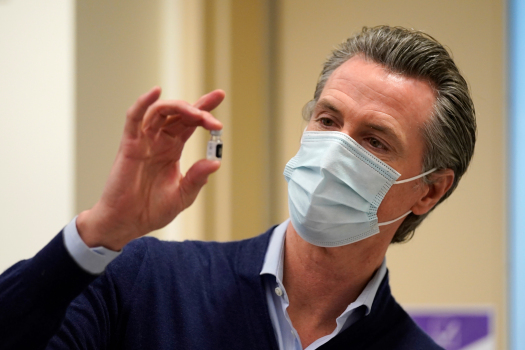
California Gov. Gavin Newsom holds up a vial of the Pfizer-BioNTech COVID-19 vaccine at Kaiser Permanente Los Angeles Medical Center in Los Angeles, Monday, Dec. 14, 2020. (AP Photo/Jae C. Hong)


As coronavirus cases, hospitalizations and deaths continue to surge in California, Gov. Gavin Newsom said Monday it’s “very likely” the state will extend into 2021 the stay-home orders affecting most residents of the Golden State.
The restrictions were set to begin expiring at the end of December for some regions, but the state plans to evaluate ICU capacity and other factors in the coming days that will likely mean more time at home.
“We are anticipating a substantial increase in the hospital surge,” Newsom said at a Monday coronavirus news conference.
Some projections forecast more than 90,000 hospitalizations in the coming weeks, with families planning to gather over the Christmas holiday despite pleas from public health officials to stay home. That could overwhelm hospitals and ICUs already straining to care for existing patients.
Hospitalizations in California have increased 63% in the last two weeks, with more than 17,000 coronavirus patients now in the hospital. ICU numbers have also increased 51%, with more than 3,640 patients needing critical care. And the death rate has climbed, to a seven-day average of 233 deaths a day. The testing positivity rate has also crept up from less than 9% two weeks ago to 12%.


The seven-day average for cases reached 37,892 over the weekend, and while that’s slightly below the previous average, Newsom said it’s too early to tell whether the latest figures signal good news.
Statewide, the state has just 2.5% capacity at intensive care units, including 0% in Southern California and the San Joaquin Valley. In the Bay Area, ICU capacity stands at 13.7%, just below Greater Sacramento’s 16.2%. The only area in the state not under a stay-home order remains Northern California, where ICU capacity sits at 28.7%.
When a region has 0% ICU capacity, it doesn’t necessarily mean it doesn’t have any ICU space available, but rather that hospitals must activate surge beds and staff they don’t ordinarily use.
“We are worried that certain regions do exceed their existing capacity and even may go beyond the existing surge capacity they currently have planned,” warned Health and Human Services Secretary Mark Ghaly, noting that about 12% of today’s cases will require hospitalization, and 12% of those will likely require ICU admission.
Stephen Parodi, an executive vice president with Kaiser Permanente, said the healthcare giant has tapped cardiologists to help out with intensive care and postponed even outpatient elective procedures to devote staff to those spending the night in the hospital.
In Kaiser’s Northern California region, Parodi said, coronavirus patients account for 40% of hospitalizations, half of all ICU patients, and a quarter of ventilator use. A third of ICUs are close to full, and at a couple of hospitals, entire ICUs are occupied by those with COVID-19. Unlike some smaller hospitals, Kaiser still has the ability to meet demand by transferring patients within its own network, but that’s getting more complicated as hospitalizations rise.
“Those are really significant numbers that we’ve never seen in the course of the pandemic so far,” Parodi said.
“I’m extremely concerned that with the coming Christmas and New Years holidays,” he added, “that if we repeat the same kind of behavior that occurred with Thanksgiving Day, we’re going to look at a much worse situation.”
Kaiser is not alone. San Mateo County on Monday announced it would spend $4.5 million to add 10 ICU beds at Dignity Health’s Sequoia Hospital in Redwood City. The beds will be staffed by more than 40 medical workers from AMI Expeditionary Healthcare, which provides medical services, and are meant to serve not just the county but the Bay Area region in the face of the ongoing surge.
“It does appear as if we are heading for a surge upon a surge,” said Louise Rogers, chief of San Mateo County Health.
The county is also using more than 80 hotel beds to house people who don’t need the level of care a hospital provides but who don’t have a safe, uncrowded space to recover.
To the south, Santa Clara County opened DePaul Health Center in Morgan Hill on Dec. 15 to care for “step down” patients who no longer need hospital-level care. There are currently 12 patients at DePaul, a spokeswoman said Monday.
Already, the state has opened four “alternative care” sites, including at the Sleep Train Arena in Sacramento, and could open at least that many more. The sites are currently caring for 62 patients, but that number is likely to rise. One of the sites is in hard-hit Imperial County, where Newsom has requested an extension of federal help through January.
“It looks very, very favorable,” he said.
In the past, places like Imperial County transferred patients elsewhere. But as COVID-19 surges across the state, that becomes less of a possibility.
Yet, the largest challenge at many hospitals is not bed space or personal protective equipment like masks and gloves, but staffing, with the traveling nurses that have typically offered some relief in high demand across the country.
The state has already dispatched 607 staff to help at 75 facilities across 24 counties, Newsom said, and is requesting more federal help, including 10 teams of 20 Department of Defense staffers.
The state is also considering implementing a new quarantine protocol for visitors from the United Kingdom, where a new strain of the coronavirus is raising alarm, because “exposure … may mean you’re more likely to get infected,” Ghaly said .”That is why we’re worried.”
So far, the new strain has not been found in California.
There is a bright spot amid all the dire coronavirus data, however: More than 70,000 people in the state have received the first dose of Pfizer’s coronavirus vaccine and hundreds of thousands more frontline workers are expected to be inoculated this week.
Some 560,625 doses of the Pfizer vaccine should arrive this week, Newsom said, along with more than 670,000 doses of the newly approved Moderna vaccine.
“This is an extraordinary accomplishment,” Newsom said.
The governor acknowledged the Pfizer shipments are about 40% below what the state had anticipated because of an error at the federal level, but Newsom complimented the Trump administration and said they “deserve credit” for working to distribute the vaccine.
“We are so often too quick,” he said, “to be judgmental.”


