

While Europe and North America battle to turn the tide of the COVID-19 coronavirus pandemic, the virus is also taking hold in the developing world where governments are far less able to fight back.


No country can face the pandemic alone. Even the U.S. is receiving tons of equipment from Russia and China—adversaries in any normal circumstances. But the overriding tone of the COVID-19 coronavirus pandemic so far has been a nationalistic one, the prioritization of each nation’s need regardless of those elsewhere.
Some world leaders are inevitably politicizing the crisis, seeking to avoid blame for rising deaths and attacking their adversaries for their response. The pandemic is an opportunity as well as a crisis, and the global fallout offers powerful nations a chance to expand their influence.
Rather than with military bases, aircraft carriers and weapons contracts, this battle for influence will be fought with humanitarian aid, doctors and medical technology.
Nowhere is such assistance needed more than in the so-called “global south”—poorer nations with weaker states and less developed medical infrastructure. In normal crises, these nations would be heavily dependent on foreign aid, but the nations that would usually give the most are fighting their own battles.
The picture for the world’s poorest nations is grim. The keys to defeating coronavirus appear to be social distancing, widespread testing, expanding intensive care unit capacity and increasing the supply of ventilators and protective equipment.


But all of these things are privileges of the wealthy. Workers living hand to mouth cannot afford to stay at home, and poor states with weak institutions cannot afford to pay them to. Some leaders will not even want to—Brazilian President Jair Bolsonaro is the most obvious example of a leader who has repeatedly dismissed the severity of the virus, undermining public health outreach efforts.
Meanwhile, the cost of key medical equipment worldwide is rising as demand balloons, leaving little to bolster already weak healthcare systems. Some countries, particularly in Africa, have been proactive in introducing lockdown measures, but if the virus does take hold it will meet little resistance.
In the east African nation of Malawi, for example, officials have warned they have only 25 intensive care unit beds and seven ventilators in the country of more than 18 million people. In the Central African Republic, there are three ventilators for almost 5 million people, while Liberia has no intensive care units with ventilators for its 4.7 million citizens.
Elsewhere, war-ravaged nations like Iraq, Afghanistan and Syria have all been left with weak central governments and precarious finances, unable to meet a pandemic-level challenge.
One or several nations will need to step in if catastrophic death tolls and societal unrest are to be avoided. Traditionally, the U.S. would take a prominent role. But three years of President Donald Trump’s “America First” ideology has seen the U.S. somewhat abdicate its leadership position.
The U.S. has been slow to react, and now looks set to record the most cases and deaths from COVID-19—at least in the first wave and if China’s figures are to be believed. Trump—the self-declared “wartime president”—has been unable to formulate a coherent federal response, let alone make meaningful plans to help other nations.
Notoriously transactional in his foreign policy, Trump’s track record in international relations, disaster relief and his conduct thus far in the coronavirus crisis do not promise adequate help for poorer nations abroad. Even his Democratic critics have called for restrictions on medical exports.
Ivo Daalder, a former U.S. Ambassador to NATO under President Barack Obama and a National Security Council staffer under President Bill Clinton, told Newsweek that what we are seeing is “America’s abdication of global leadership.” The White House response has “exemplified” Trump’s “America First” approach, Daalder argued.
With the exception of banking and science, Daalder suggested that the “U.S. is absent” in global leadership. French President Emmanuel Macron, not Trump, was the leader to push for the emergency G7 meeting. The United Nations Security Council has been largely inactive, and last month’s G20 meeting ended with little of note on coronavirus.
Daalder said there is “a predisposition” within the Trump administration to back away from international cooperation. This is exacerbated by the fact that the domestic crisis is so pressing that multilateral collaboration and foreign aid “take a secondary if not tertiary seat.”
Daalder said that even before COVID-19, there was a global trend of “increased nationalism and decreased globalization,” and certainly decreased willingness to collaborate to tackle global problems. “COVID-19 just reinforces all of that,” Daalder explained.
Crisis into opportunity
Chinese President Xi Jinping has made no secret of his desire to propel China into a global force capable of challenging U.S. China appears to be over the worst of its outbreak, though more waves may come as restrictions are lifted.
Beijing is now pivoting to assist others, whether for altruistic or public relations reasons. China is sending medical personnel and supplies—some of which have been rejected as faulty—around the world. COVID-19, initially a crisis that started in China, could yet offer Beijing a chance to expand global influence if it plays its cards right. This weekend, Xi said China would work alongside developing nations to help them prepare for and react to the pandemic.
For years China has been expanding its global footprint. Chinese commercial clout has opened doors on every continent and where firms go the regime does too. Being able to lead other nations through the pandemic that started in China would be one of the better outcomes for Xi, whose government has been trying to dodge blame for the tragedy.
According to Max Baucus—the former U.S. ambassador to China who served as a senator from Montana for more than 35 years—Beijing will look to help other nations for both altruistic and geopolitical reasons. Xi, he said, “wants many countries in the world to know that they’re stepping up to a leadership role.”
But China is not yet a true challenger to the U.S. on the world stage, despite its meteoric rise to prominence. Some European countries have rejected shipments of vital medical supplies from China as faulty, for example.
Baucus said that Beijing is now starting to crack down on such oversights, but Jacques deLisle—a professor at the University of Pennsylvania Law School and an expert in Chinese law and politics—said such failings showed how China is “still very new to many of these undertakings.”
Still, China’s financial clout and manufacturing base puts it in prime position to send aid elsewhere, as long as the material is reliably high quality. “The stuff that is necessary around the world is coming out of China because that’s where its components are made,” deLisle explained.
China’s authoritarian system means Beijing can play the long game in a way that the U.S. cannot. Baucus cited the country effectively taking control of the South China Sea without a shot being fired. “It can make decisions for the long term, which are not really understood until it’s almost too late,” Baucus told Newsweek. Coronavirus offers an opportunity to advance the long-term strategy.
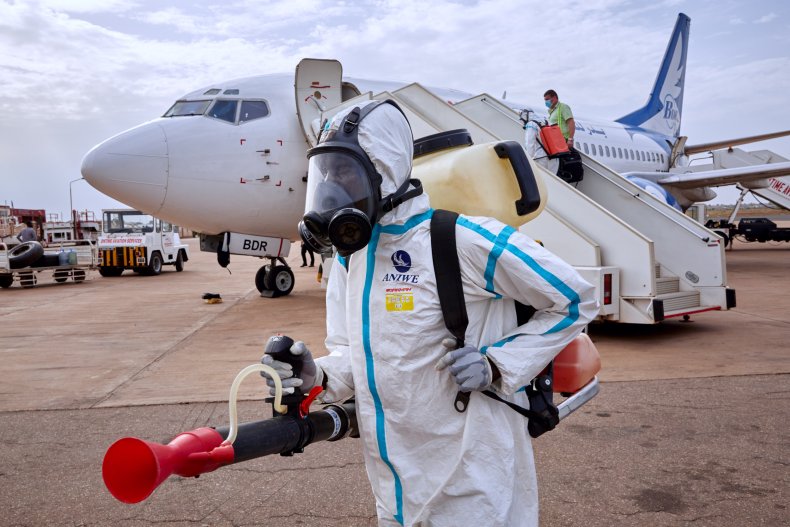 Airport staff disinfect a plane after it landed at Juba International Airport in Juba, South Sudan on April 3, 2020. ALEX MCBRIDE/AFP via Getty Images/Getty
‘The leadership is gone’
Poor countries will also likely look to Russia and the European Union for aid, though neither is able to operate at the same level as China or the U.S. Still, the Kremlin is not one to pass up good propaganda opportunities, as shown by its delivery of medical gear to the U.S. last week. Opportunistic President Vladimir Putin is always looking for areas in which to expand Russian influence—for example in Africa and South America—despite the economic and political difficulties he faces at home.
The EU—long described as a potential superpower in waiting, though one still lacking coherent foreign policy—is busy grappling with its own internal disputes. The 2008 financial crisis and 2015 migrant crisis both exposed deep divisions between the union’s northern and southern nations, fissures that have never truly been repaired.
European nations are sharing patients, but the union states have also been competing over medical supplies and closing their borders. Another debt crisis is brewing over so-called eurobonds, which would share the financial burden of the coronavirus crisis across nations. But Germany and the Netherlands have led the opposition to such a plan, setting the stage for another internal showdown.
Alongside the internal disputes, the EU has also moved to limit medical exports to countries outside of the bloc, demonstrating the union’s priorities. The bloc also took a tough line on a new wave of refugees arriving from Syria via Turkey at the start of this year—a far cry from German Chancellor Angela Merkel welcoming refugees in 2015.
“What I’m worried about is that there will be quite a coherent, effective European approach eventually, but it will come at the expense of Europe helping poorer nations,” said Hans Kundnani, a senior research fellow at Chatham House. With European nations “overwhelmed,” Kundnani said, Europe could yet “pursue a Trumpian kind of policy of building a wall.”
For now, the U.S. remains the best candidate to lead a global response to such a crisis. Once the country flattens its curve and turns the corner, it could be that the White House begins looking outward and—presumably armed with a huge supply of medical necessities—throws its weight behind less fortunate nations, though this is far from guaranteed.
Daalder said the pandemic is “the perfect storm to fundamentally overthrow a post-World War Two order that was based on American global leadership to address big global problems.” He added: “The leadership is gone, America is no longer willing to do it. And it’s not clear that anybody else is able or willing to step in, including the Chinese.”


