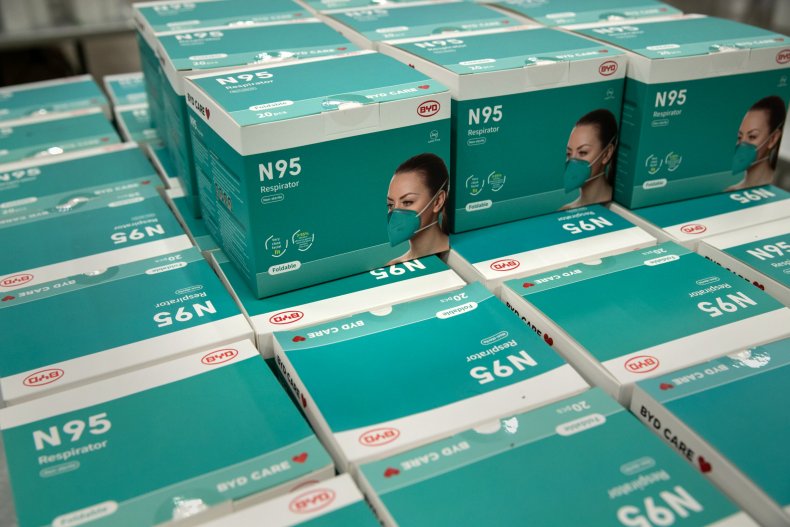
As the U.S. prepares for a potential second wave of the coronavirus pandemic, health care workers on the front lines claim there is still a critical shortage of medical N95 respirators and other personal protective equipment (PPE).


Rachel Spray, a nurse at Kaiser Permanente Fresno Medical Center in Fresno, California, told the Associated Press that hospital management continues to ration its supplies, keeping the masks under lock and key.
Spray’s observations spark worry that, if the U.S. is to experience another rapid influx of new COVID-19 infections similar to what was seen in New York in early spring, there would not be enough PPE to go around.
“N95s are still in a shortage,” Mike Schiller, the American Hospital Association’s senior director for supply chains, told the AP. “It’s certainly not anywhere near pre-COVID levels.”
Newsweek subscription offers >
There is still much pressure on the U.S.’ medical supply chain, and in “many ways things have only gotten worse,” Dr. Susan Bailey, the American Medical Association’s president, said in a recent statement.


Health experts continue to express their concerns despite repeated messaging from White House officials who insist that U.S. hospitals have sufficient PPE supplies needed to handle the coronavirus.
In an August interview, White House trade adviser Peter Navarro pushed back at reports of PPE shortages.
“We have what we need to get the people what they need,” he told the AP.
Newsweek subscription offers >
But an AP investigation found that it took the Trump administration months to sign contracts with companies that make meltblown textile, the crucial component in the production of N95 masks.
The White House has also not specifically restricted exports of the material, meaning that U.S. meltblown makers have continued sending their goods overseas during the course of the pandemic, according to an AP analysis.
Meltblowing is a manufacturing process which transforms plastic into a dense mesh, making the N95 masks so effective at blocking minuscule particles like coronavirus.
Front-line workers caring for COVID-19 patients who don’t have access to N95 masks remain at the highest risk of infection, according to a study published this summer in the medical journal The Lancet.
“In the UK and the USA, risk of reporting a positive test for COVID-19 was increased among front-line health-care workers,” the study found. “Health-care systems should ensure adequate availability of PPE and develop additional strategies to protect health-care workers from COVID-19, particularly those from Black, Asian, and minority ethnic backgrounds.”
Hospital best practices dictate that health care workers should use one N95 mask per patient visit, meaning that a single nurse could go through several masks per day. Spray told the AP that she typically gets one N95 per shift.
Kaiser spokesman Marc Brown did not dispute this claim with the AP, but he stressed that members of the clinical staff are still able to safely care for patients.
“We continue to prudently manage PPE supplies to ensure they are readily available to protect our health care workforce for the duration of this pandemic,” Brown told the AP.
The U.S. Food and Drug Administration included N95s (identified by its product code “MSH”) in its most recent medical device shortage list. Officials added the surgical respirator on August 14, citing a “demand increase for the device” that would last for the “duration of COVID-19,” and marked its availability as “limited supply.”
Newsweek contacted the Federal Emergency Management Agency, which manages the Supply Chain Stabilization Task Force, for comment, but did not hear back in time for publication.